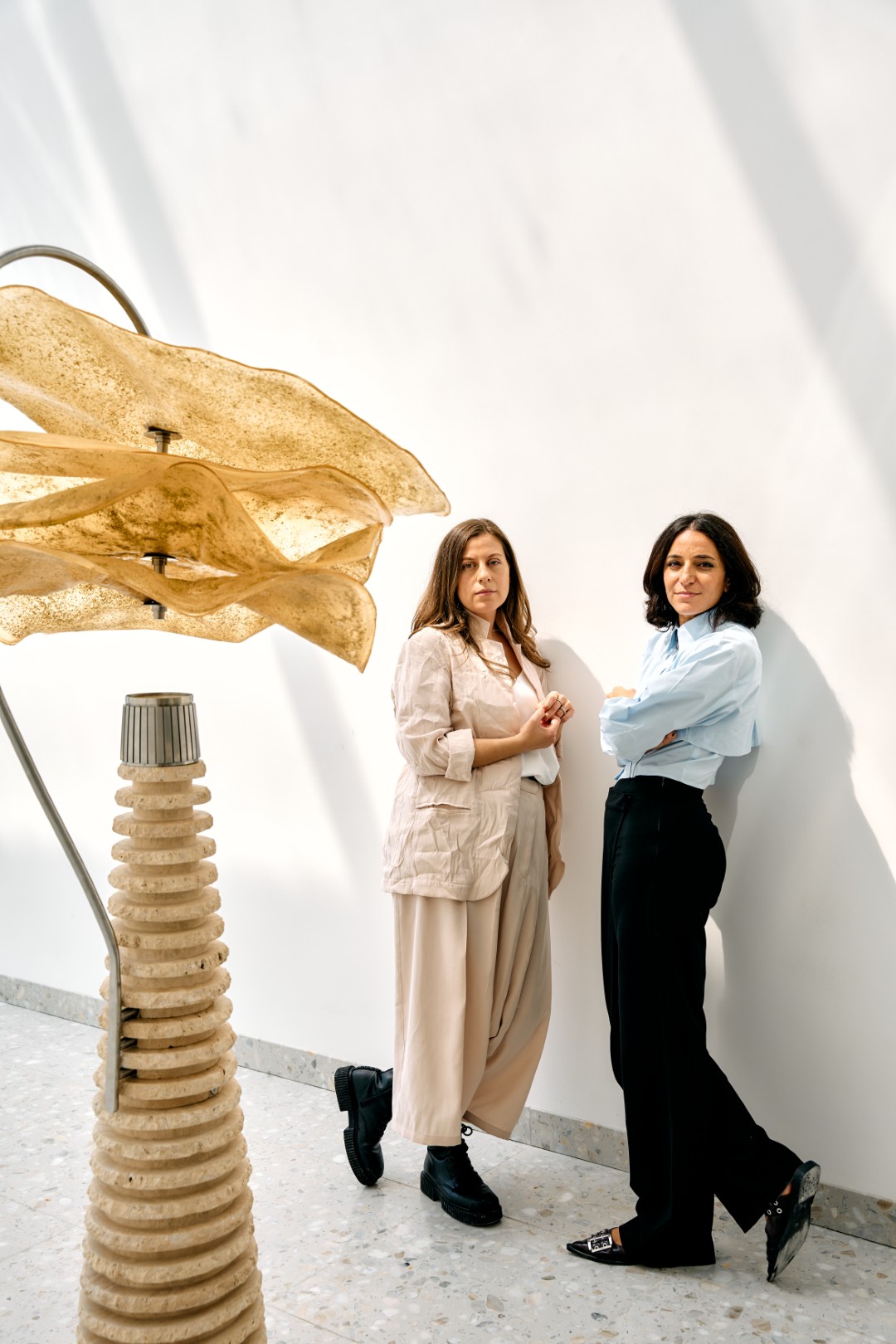
In a region where hospitality has long existed as both ritual and identity, designers Joud Malhas and Rachel Antoun chose to reinterpret that legacy not through nostalgia, but through sensory experience. Their winning installation, Where There Is Uns, created for the 11th edition of the Van Cleef & Arpels Emergent Designer Prize in partnership with Tashkeel, moves beyond the idea of an object and becomes something more atmospheric: a gesture of welcome translated into light, material, and interaction.
Selected under this year’s theme, Blooming Poetry, the project stood out for the way it fused storytelling with innovation. Rather than approaching design as decoration, the duo explored how space and objects can carry emotion, cultural memory, and human connection.
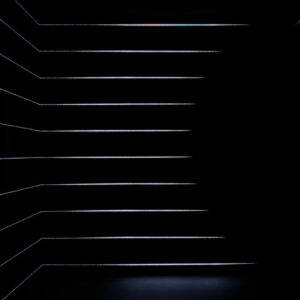
At the centre of the installation is a poetic reinterpretation of the Bedouin tradition of lighting fires to guide and welcome travellers crossing vast landscapes. Malhas and Antoun translated this idea into a sculptural lighting piece that responds to human proximity, intensifying its glow as someone approaches. The effect is subtle yet deeply emotional, transforming interaction into part of the narrative itself.
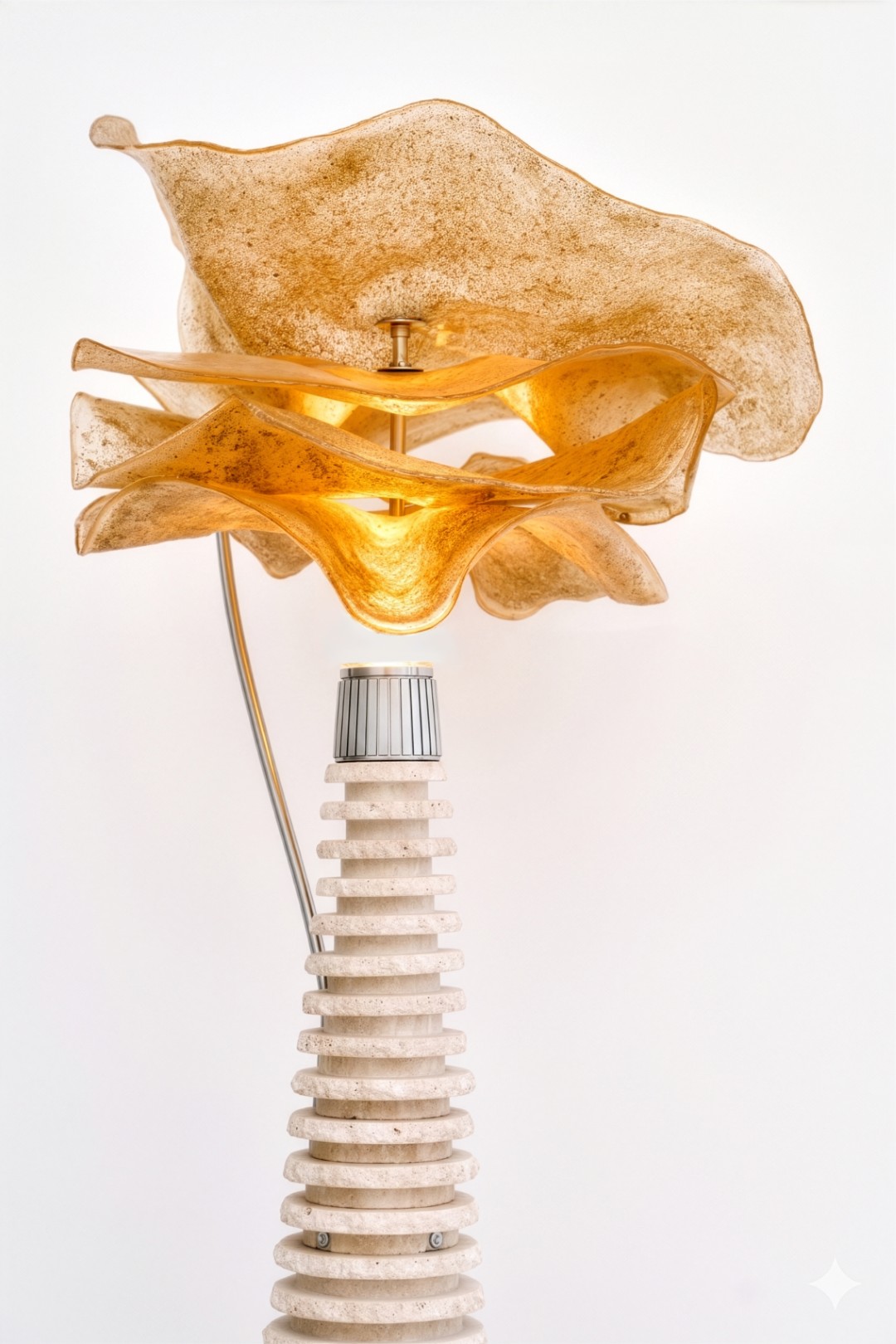
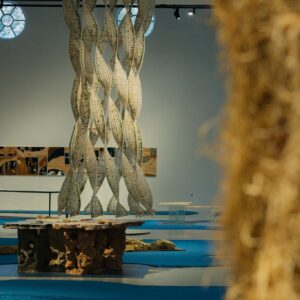
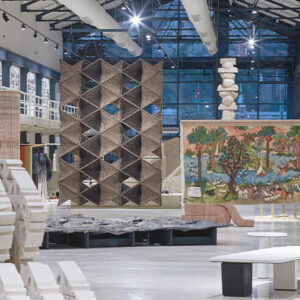
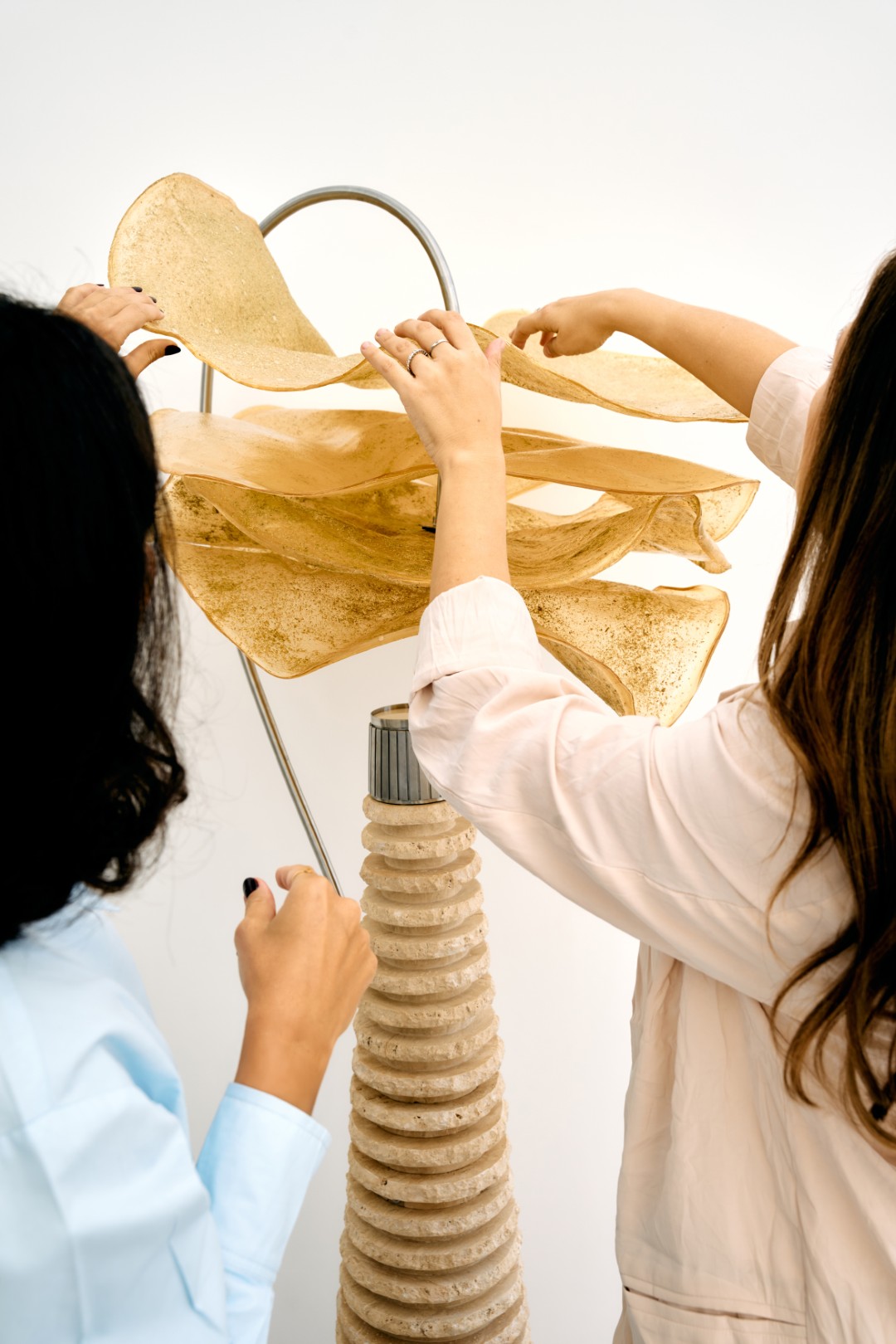
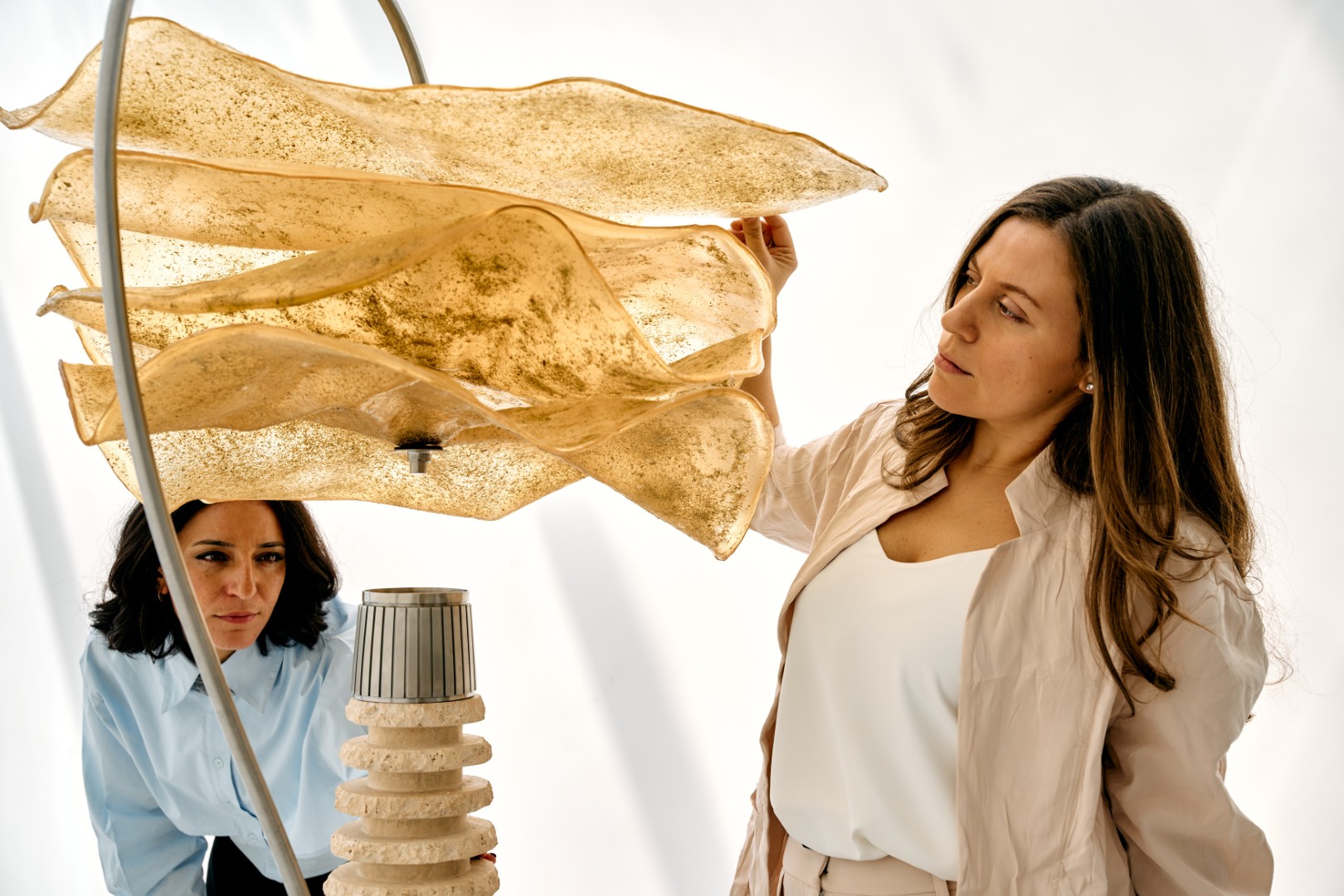
The installation draws heavily from the region’s rituals of gathering and generosity. Cardamom, essential to Arabic coffee culture, becomes both symbol and material. Discarded cardamom husks are repurposed into translucent bioplastic sheets layered above the structure, creating an organic composition that feels suspended between fragility and permanence.
These undulating layers catch and diffuse light softly, producing warm halos that echo the intimacy of shared spaces. Travertine rings anchor the structure below, introducing a contrasting sense of weight and permanence. The balance between the controlled geometry of stone and the fluid movement of the bioplastic reflects the project’s broader dialogue between nature and design, tradition and experimentation.
What makes Where There Is Uns particularly compelling is the way technology disappears into emotion. The installation avoids conventional switches entirely. Instead, a ribbed dimmer inspired by the unfolding of a cardamom leaf activates the light through touch, while infrared sensors heighten the illumination as visitors move closer. The result feels less mechanical and more instinctive, almost human in its response.
The project also reflects the distinct but complementary practices of its creators. Joud Malhas, a Jordanian designer based in Dubai, has built her career around spatial strategy and experience design, often focusing on environments that encourage adaptability and community. Her background spans residential, workplace, and co-living concepts, including Hive Co-liv, recognized as the UAE’s first co-living development.
Malhas’ practice is rooted in understanding how people emotionally interact with space. Educated at IE School of Architecture and Design in Madrid, with further studies at London’s Royal College of Art, she approaches design through research, ethnography, and human behavior. That sensitivity is evident throughout Where There Is Uns, where interaction becomes central to the experience itself.
Rachel Antoun, meanwhile, brings a material-driven perspective shaped by her background in interior architecture and new materials design. After studying at the Lebanese University and later completing a Master’s degree at Elisava in Barcelona, Antoun developed a multidisciplinary approach that treats materiality as narrative rather than surface treatment.
Her work frequently exists at the intersection of experimentation and emotion. Whether through immersive public environments, conceptual interiors, or UV-sensitive lighting installations, Antoun’s projects investigate how texture, form, and material can evoke memory and atmosphere.
Together, their collaboration feels particularly timely within the UAE’s evolving design landscape. Rather than simply referencing heritage visually, they engage with it through process and behaviour. Sustainability is not added superficially, but embedded into the project’s very structure through the reuse of organic waste materials and the creation of biodegradable bioplastics.
The installation also reflects the multicultural fabric of the Emirates itself. Hospitality becomes less about a singular tradition and more about coexistence, openness, and shared experience. In that sense, Where There Is Uns quietly captures a wider regional narrative: one where contemporary design increasingly acts as a bridge between memory, innovation, and collective identity.
Now in its 11th edition, the Emergent Designer Prize continues to position itself as a platform for nurturing regional talent across the GCC, encouraging designers to explore functional works through material innovation and cultural storytelling. As part of the award, the winning designers will participate in immersive educational experiences through L’ÉCOLE, School of Jewelry Arts, supported by Van Cleef & Arpels, both in Dubai and Paris.
Yet beyond the recognition itself, Where There Is Uns signals something larger about the future of regional design. It suggests a move away from spectacle and toward emotional resonance. A future where objects are not only seen, but felt. Where sustainability is poetic rather than performative. And where light, memory, and hospitality can become a language of their own.
For more stories of art and culture, visit our dedicated archives and follow us on Instagram.