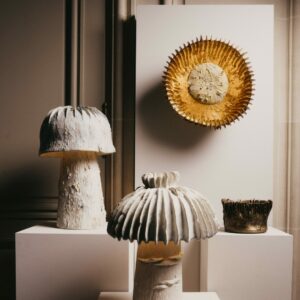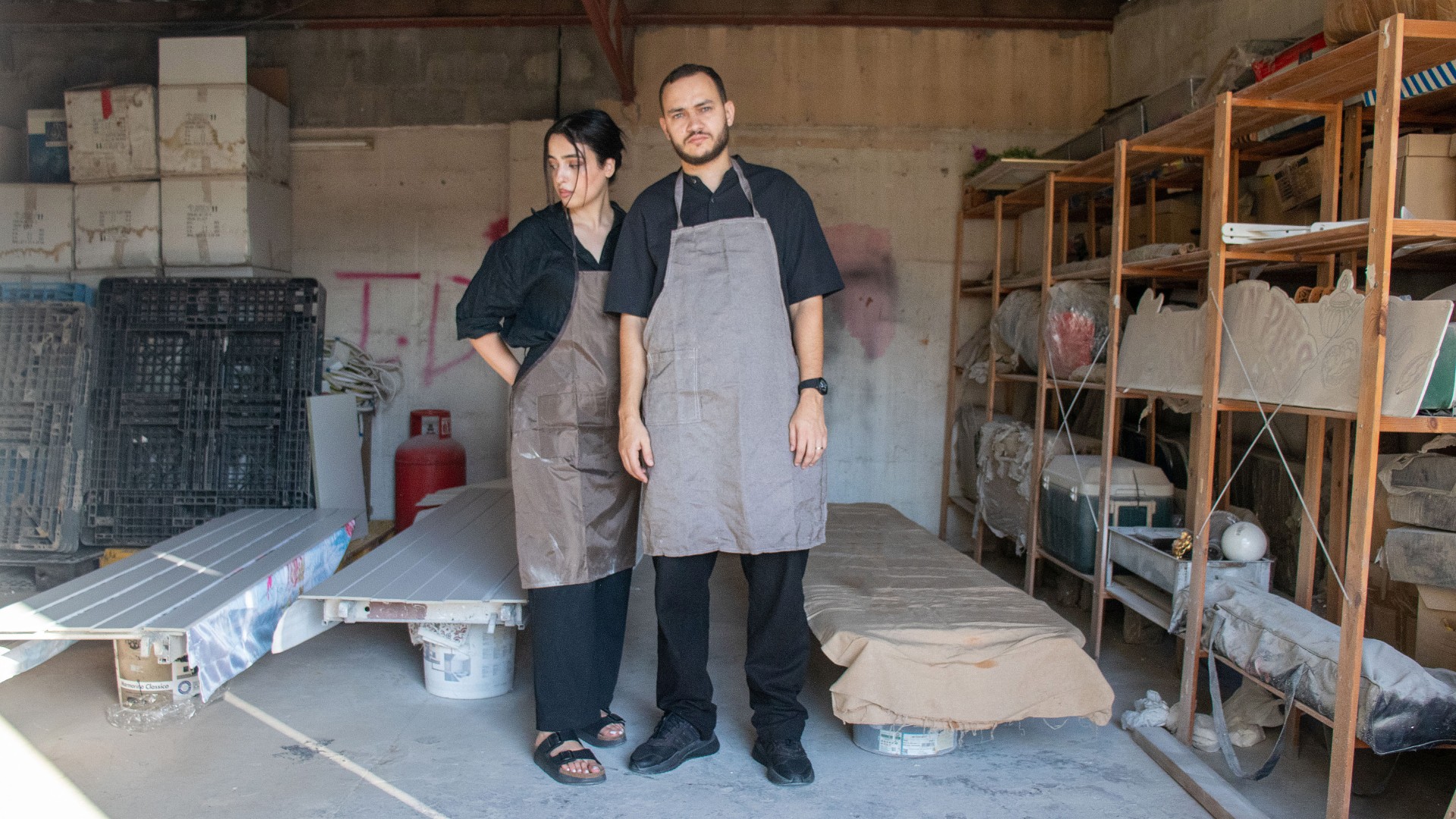
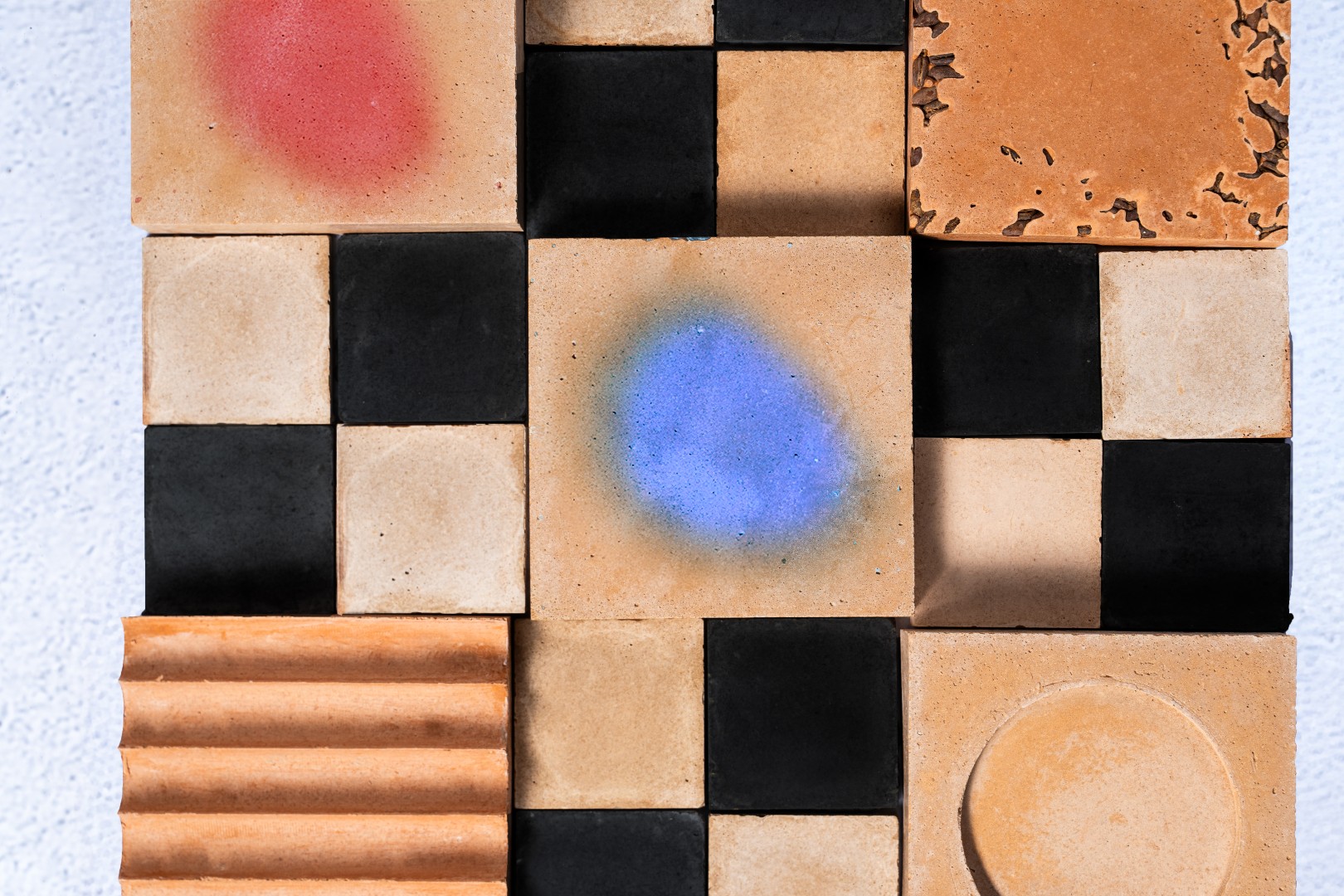
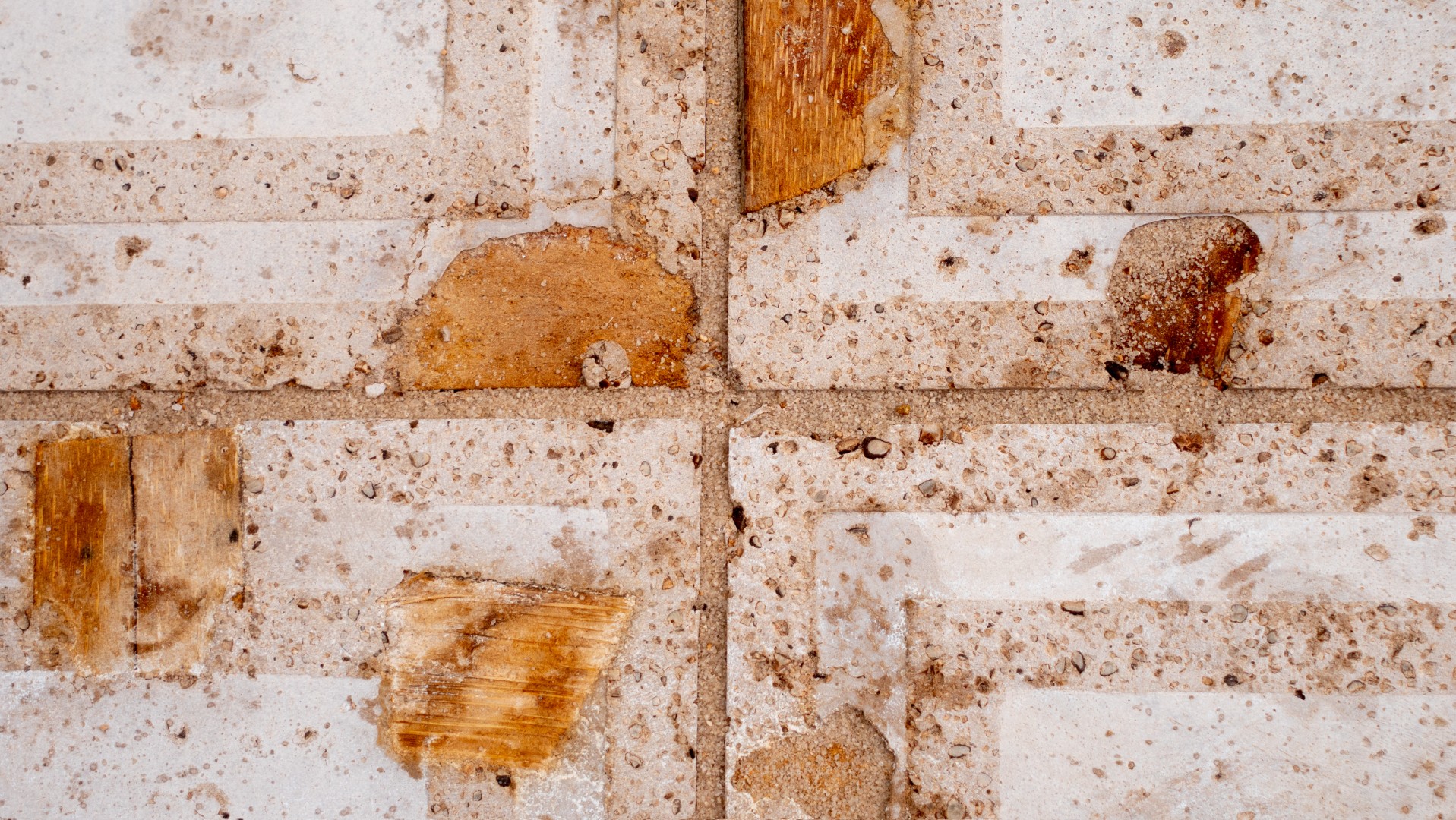
Datecrete Studio & Lab is rethinking what buildings can be made from, starting with something as overlooked as a date pit. Co-founded by Sara Farha and Khaled Shalkha, the interdisciplinary studio merges material science, design, and environmental research to create sustainable construction materials rooted in the MENA region. Their signature innovation transforms discarded date seeds into a high-performance cementitious composite, bridging ancient building knowledge with contemporary experimentation.
How do your different backgrounds in urban planning, material research, and chemical engineering complement one another creatively?
We’ve always believed that meaningful work usually happens at the overlap between seemingly unrelated fields. Beyond our formal backgrounds, we’re also deeply influenced by art, film, music, and visual culture. This is foundational to who we are as people.
A lot of ideas come from reconnecting things that have become unnecessarily siloed. In our case, food systems and construction had stopped speaking to one another; a separation reinforced by how academia is structured. Datecrete really began through intuition first, through educated guesses and connecting distant points of research that didn’t initially seem related, followed by the scientific validation.
How important was it for Datecrete to feel regionally rooted?
It was important, but not in a nostalgic or performative way. We weren’t interested in creating the optics of rootedness or romanticizing the past. What interested us was understanding the region’s broader cementitious history critically: Why were certain historical binder systems abandoned so quickly after industrialization? Why couldn’t they compete with Portland cement at scale? Those questions became more interesting to us than simply reproducing old techniques. Datecrete is less about returning backward and more about reconnecting interrupted lines of material knowledge, while allowing industries like food and construction to speak to each other again.
What conversations are you hoping Datecrete sparks around value, waste, and materiality?
Probably the importance of interdisciplinary thinking and what we’d call pragmatic idealism. We try to balance optimism with critical analysis and we’re not interested in romanticizing waste or the past for aesthetic reasons alone. We’re more interested in studying systems carefully, understanding their failures and successes, and extracting usable lessons to balance imagination and practicality, which is where we feel our real strength lies.
What did your journey teach you about patience and innovation?
Our process may begin experimentally, but there’s always equal emphasis on validation, on making and on implementation. Experimentation without testing eventually becomes a temporary project. What the research taught us most is that innovation often comes from stepping outside your disciplinary comfort zone. A lot of answers remain invisible if you ignore the overlap between different fields of study. Patience is necessary because meaningful material development is rarely linear, you test, fail, recalibrate, and slowly begin understanding the logic of the material rather than imposing assumptions onto it.
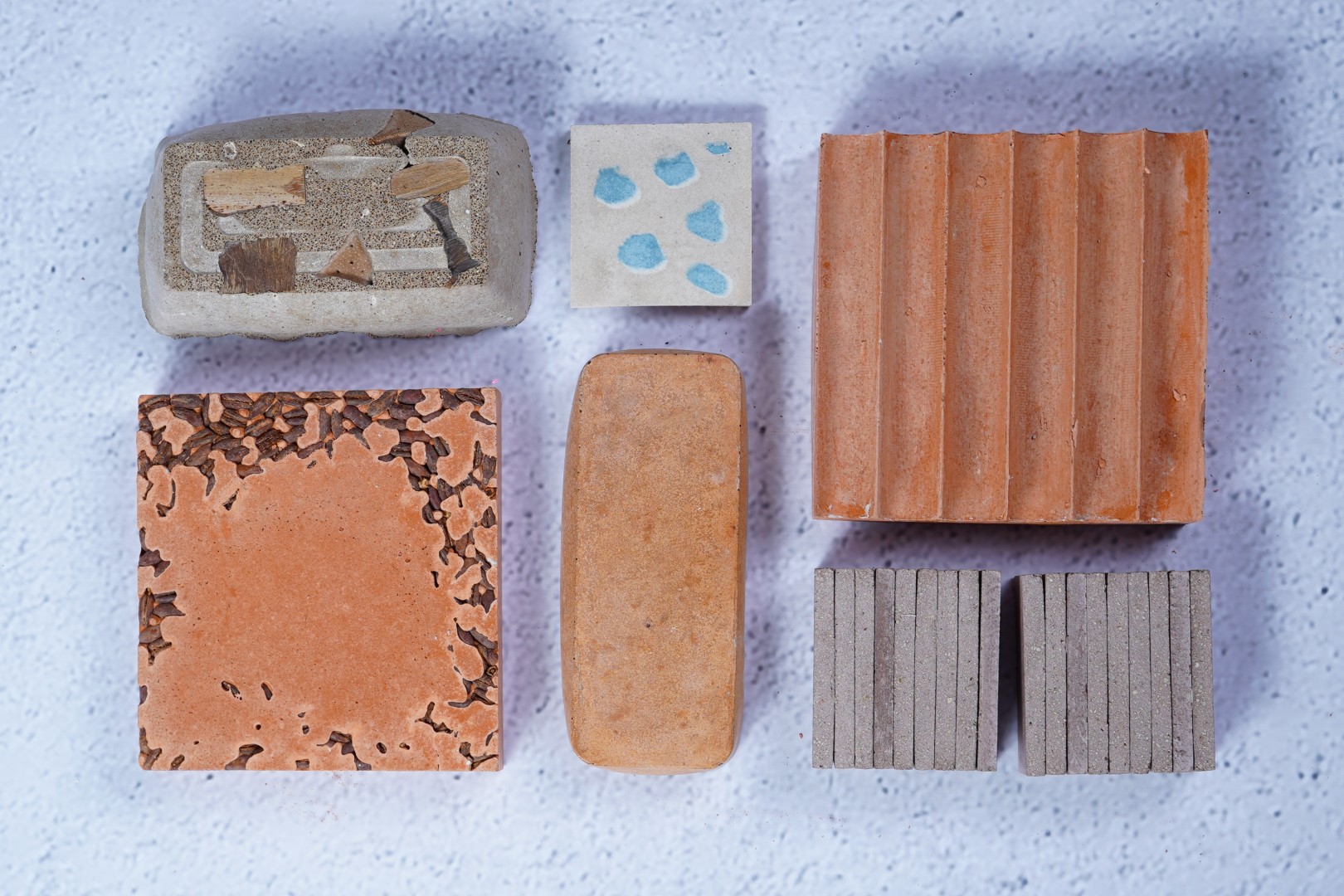
Datecrete challenges the idea that high-performance materials must feel industrial or detached from nature. Do you believe the future of design lies in reconnecting technology with organic materials?
We do, but carefully. Organic materials alone are not automatically sustainable, and technology alone is not inherently harmful. A healthy future probably lies in dissolving this false separation between technological advancement and ecological intelligence. For us, the question is about building material systems that are regionally intelligent, resource-conscious, and scientifically rigorous while retaining warmth, an aromatic dimension, tactility, and emotional resonance.
For more stories of art and culture, visit our dedicated archives and follow us on Instagram.