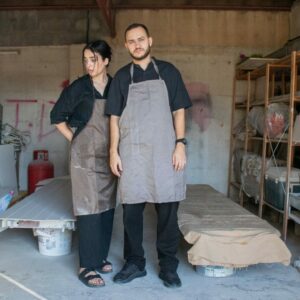
What does it mean to share a space with someone you have never met, thousands of kilometres away? For French-Moroccan artist Sophia Kacimi, founder of ZOUBIDA, the answer begins with something beautifully familiar: the living room. At Design Doha 2026, her installation Sharing the Same Roof transforms the traditional Moroccan salon into a playful architectural experience, bringing two cities, two communities and generations of craftsmanship together beneath one shared sky.
Commissioned by the Design Doha Biennale, the installation is Kacimi’s largest and most collective work to date. Conceived as two identical, vibrantly coloured structures, one in Doha and the other in Fès, Morocco, the project connects visitors through live video. Sit on a pouf in one city and you encounter someone occupying the very same spot in the other. A stranger becomes a temporary companion, turning geographical distance into a moment of unexpected intimacy.
The concept is deceptively simple, yet its emotional resonance extends far beyond the installation itself. By recreating the Moroccan salon, a space traditionally associated with family, hospitality and gathering, Kacimi transforms an intimate domestic setting into a shared public experience.
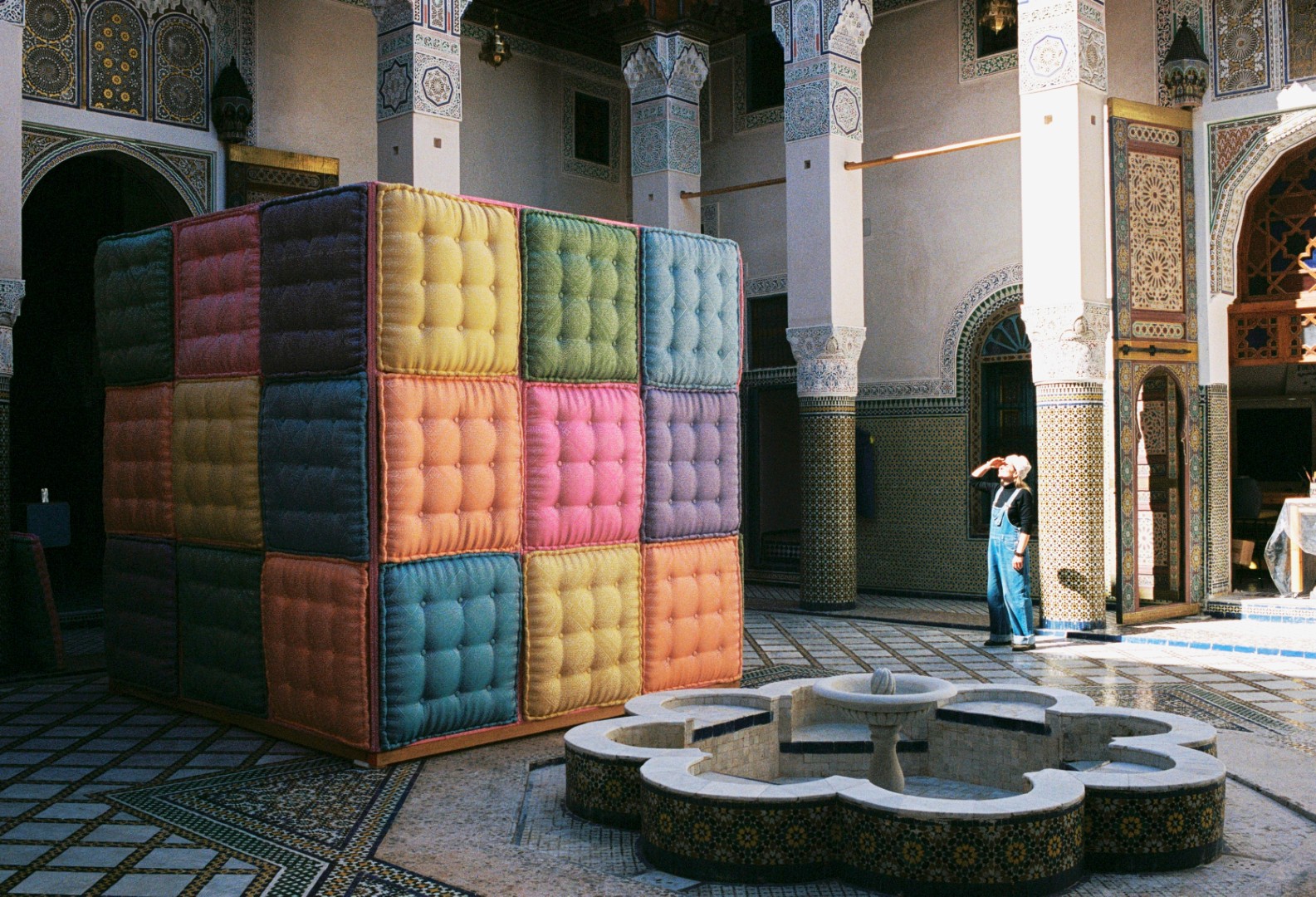
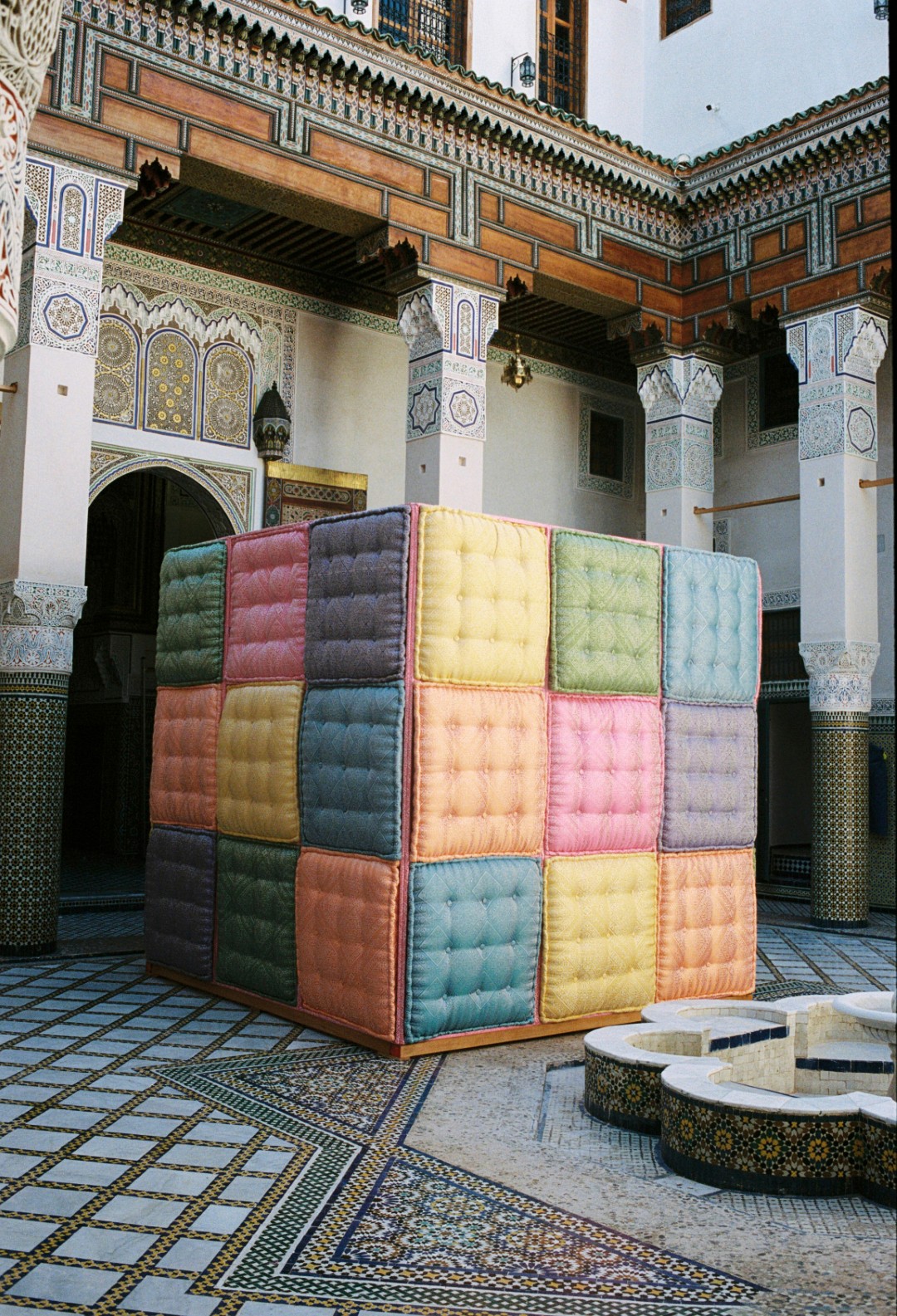
Cushions, poufs and richly patterned brocades are exaggerated into monumental forms, stacked into an architectural structure resembling a giant Rubik’s cube. Visitors are encouraged to enter, explore and interact with the installation, discovering a familiar space reimagined through an almost dreamlike explosion of colour and scale. There is something of Niki de Saint Phalle’s joyful, larger-than-life artistic spirit in its playful proportions, yet its identity remains deeply rooted in Moroccan craftsmanship.
“The cube has no roof. The sky above is the one we already share,” she says.
This poetic idea, central to the project’s concept, captures its underlying message: while borders and distances may separate us, certain experiences remain universal.
For Kacimi, whose practice exists at the intersection of art, fashion and design, the installation is also an opportunity to bring traditional craftsmanship into an entirely contemporary conversation. Having previously worked in merchandising for Chanel, Louis Vuitton and Burberry, she combines an understanding of luxury with a commitment to preserving and reimagining Morocco’s artisanal heritage.
At the heart of Sharing the Same Roof is Tarz el Fassi, a centuries-old embroidery tradition from Fès historically practised by women within their homes. A single pattern becomes the defining visual language of the installation, covering the interior and transforming a domestic decorative element into an immersive artistic statement.
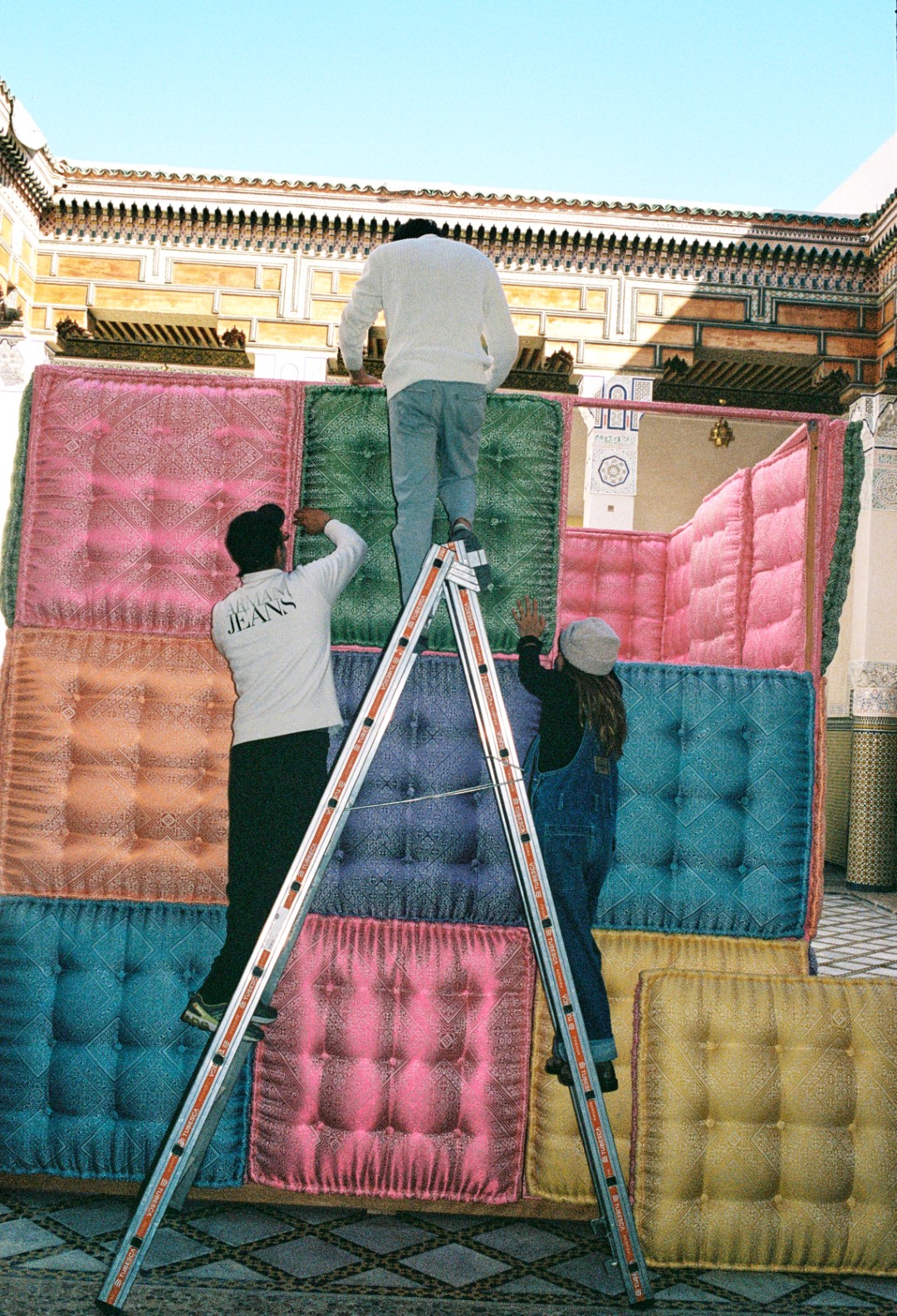
Every other element was produced in the medina of Fès, drawing exclusively on its traditional crafts. Nothing was imported or outsourced. In an industry increasingly shaped by mass production and technological acceleration, that decision feels particularly meaningful.
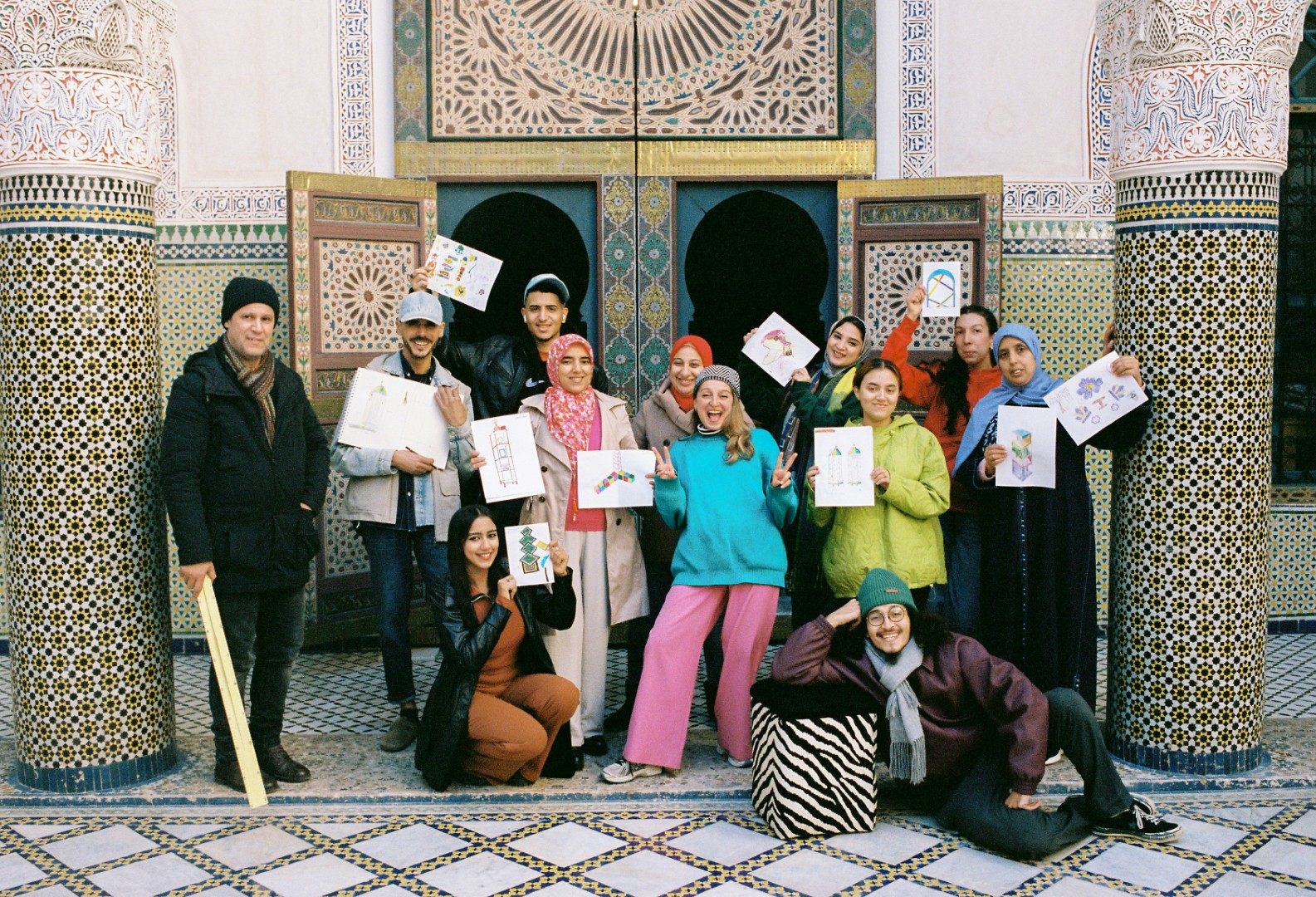
More than 50 people from the medina, spanning several generations, contributed to the installation’s creation. Master artisans representing eight traditional crafts worked alongside young students from Shems’y and Kan Ya Makaan, two youth-based initiatives and both connected to AMESIP, the Moroccan Association for Aid to Children in Precarious Situations.
Throughout the process, Kacimi organised workshops that encouraged the exchange of skills, ideas and perspectives. Experienced craftspeople shared techniques developed over generations, while younger participants discovered new possibilities for applying those skills in contemporary creative expression.
For many of the students, it was their first encounter with traditional craftsmanship as something living and relevant rather than a practice belonging exclusively to the past. Their names were incorporated into the artwork itself, offering recognition for their contribution and reinforcing the importance of collective authorship.
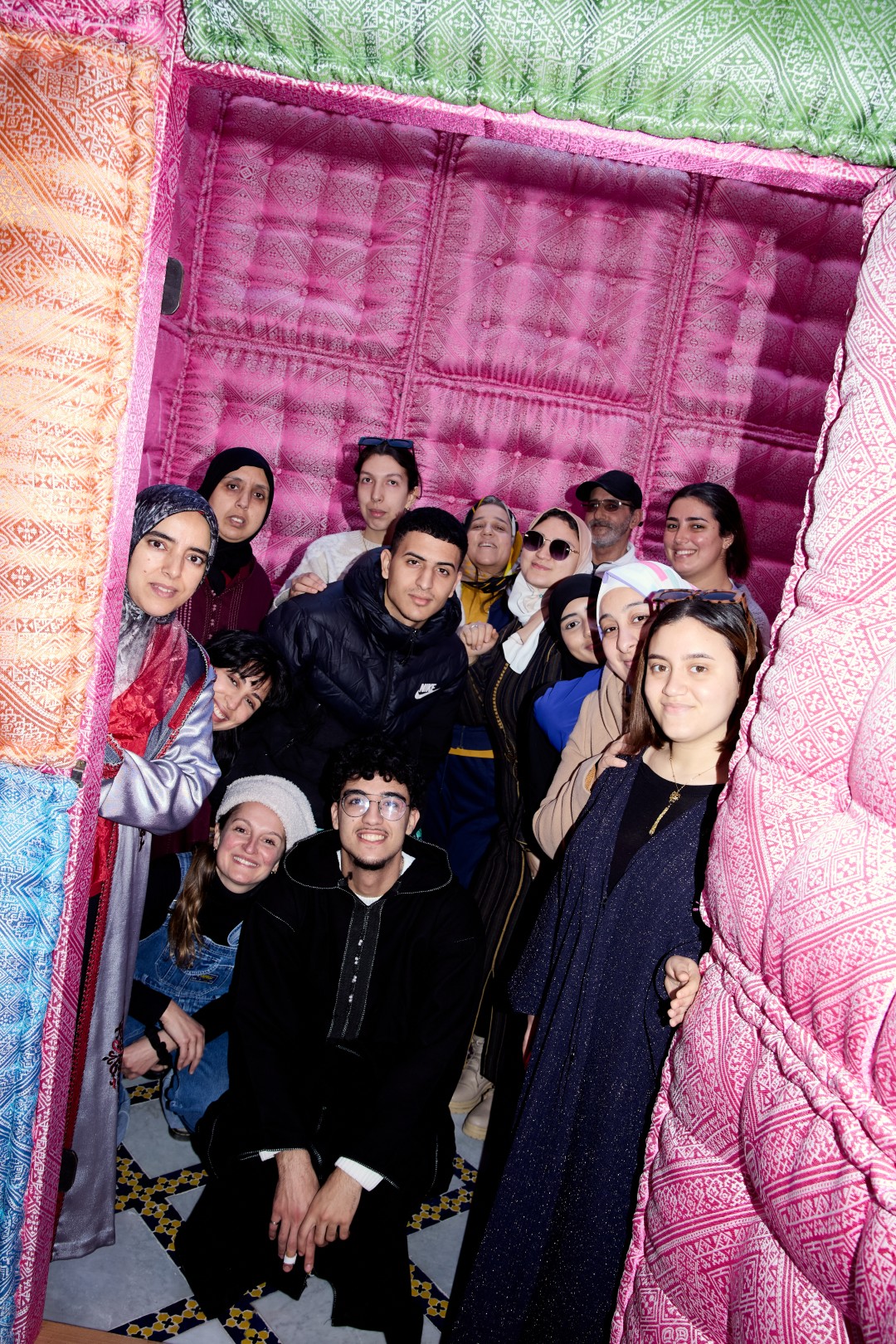
The decision to create a second installation in Fès was equally significant. Rather than allowing the work to exist only within the international context of a design biennial, Kacimi wanted the community responsible for producing it to experience and participate in its public presentation. The Fès installation remains accessible to audiences who might not ordinarily visit conventional art spaces, with participating students guiding visitors through the project they helped create.
And while many of the artisans cannot travel to Qatar, the live connection enables them and their families to witness the Doha audience interacting with the work they produced. It is an exchange that brings visibility to the hands behind the installation, challenging the often invisible relationship between artistic creation and artisanal labour.
In this sense, Sharing the Same Roof becomes far more than a colourful architectural intervention. It is an exploration of belonging, cultural continuity and the possibility of creating genuine connections across borders.
At a time when conversations about the future of design frequently revolve around artificial intelligence, digital production and technological innovation, Kacimi offers a compelling alternative. Her work suggests that the future can also be found in traditional techniques, community collaboration and the simple act of making something together.
Through ZOUBIDA, she continues to challenge perceptions of craft as something static or nostalgic, approaching heritage as an evolving language capable of inspiring new forms of expression. Colour, humour and play become tools for cultural preservation, while the participation of younger generations ensures that knowledge is not merely remembered but actively carried forward.
Ultimately, Sharing the Same Roof is a celebration of what connects us. Between Doha and Fès, 5,481 kilometres become almost irrelevant. Two rooms become one conversation, traditional objects become contemporary architecture, and the work of many hands becomes a shared experience.
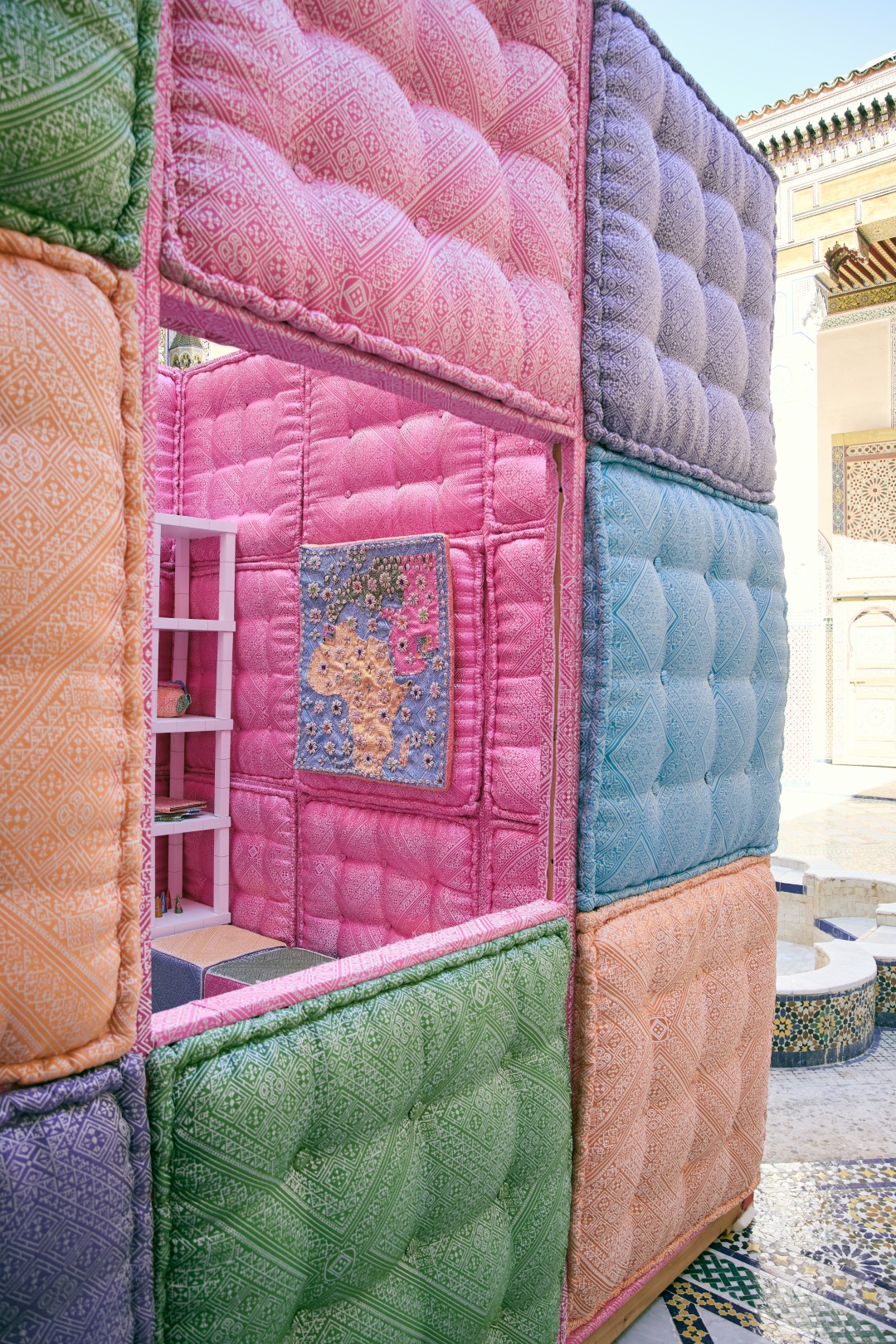
Under the same sky, Kacimi reminds us that creativity has the power not only to preserve heritage but to bring people closer together.
Sharing the Same Roof is presented at Design Doha Biennale until January 31, 2027, with connected installations in Doha, Qatar, and Fès, Morocco.
For more stories of art and culture from across the region, visit our dedicated archives and follow us on Instagram.