
There is a Friends episode that has aged considerably better than six entirely normal adults somehow affording enormous Manhattan apartments.
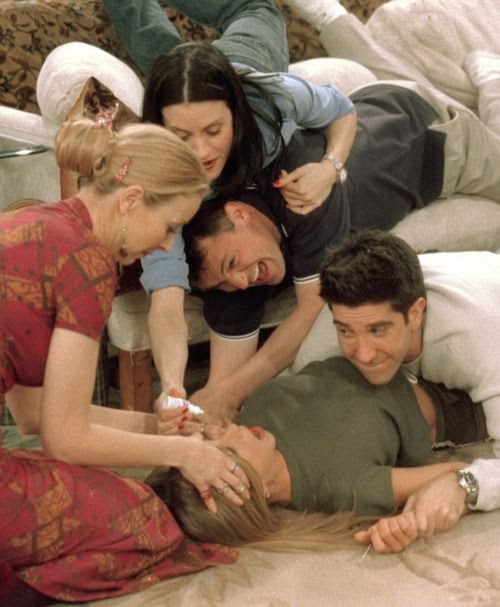
In Season Two’s “The One with Five Steaks and an Eggplant,” the group goes out for dinner. Ross, Chandler and Monica order without thinking too much about it. Rachel, Joey and Phoebe, who are earning considerably less, do not. Rachel orders a side salad. Joey gets what is essentially a tiny pizza. Then the bill arrives, and someone suggests splitting it evenly.
The fight that follows is about something much harder to admit between friends: some of us can afford this friendship more easily than others.

Almost three decades later, you probably don’t need to live in a sitcom version of New York to recognise the feeling. It’s there when the group chat settles on a restaurant and you immediately open the menu to check the prices. When someone says, “It’s only 1,500 each,” and you realise only is doing a lot of work in that sentence. When there is another birthday, another engagement, another wedding, another concert, another weekend in Sahel, another coffee that costs enough to make you reconsider whether you actually need to see anyone this week. Rather than say any of that, you just say you’re busy.
In 2026, this is no longer just an awkward conversation about who ordered the more expensive pasta. Across parts of the Arab world, years of inflation, currency depreciation and economic uncertainty have changed what it costs to participate in everyday life. Between rising grocery bills and expensive nights out, maintaining a social life has become another financial calculation.
Take Egypt. According to the Central Agency for Public Mobilization and Statistics (CAPMAS), annual urban inflation stood at 13.9% in September 2026. Restaurants and hotels recorded a 12.8% annual price increase, recreation and culture rose by 15.4%, and transportation by 21.3%. These are not abstract figures when your social calendar involves getting across Cairo, meeting friends for dinner, attending concerts or making the occasional trip to the North Coast. A night out begins costing money before you have even reached the restaurant.
The pressure is cumulative. Egypt’s inflation rate may have fallen considerably from its late-2023 peak of approximately 38%, but slower inflation does not mean prices have returned to where they were. It means they are increasing more slowly. The coffee that became expensive last year does not suddenly become affordable again because the latest inflation figures looks better.
The World Bank estimates that poverty, measured using the international lower-middle-income poverty line, increased by approximately five percentage points in Egypt between 2022 and 2024. Behind that statistic is a much broader reality: households are being forced to reconsider what counts as essential spending, and socialising can become one of the first things to go.
Elsewhere, the pressures take different forms. In Lebanon, where years of financial instability have already transformed people’s relationship with money, the World Bank projects inflation will reach 17.5% in 2026, driven partly by supply disruptions, higher shipping costs and rising energy prices. The economic strain is compounded by conflict and its effects on employment, consumption and everyday security.
Of course, the economic realities of Beirut, Cairo, Dubai and Riyadh are hardly interchangeable. Not every Arab country is experiencing the same inflationary pressures, and not every young person is struggling to afford dinner, but that difference is part of the story.

Within the same friendship group, one person might earn in dollars while another earns in local currency. One might have family support, another might be contributing to their household expenses, and someone else might be working multiple jobs just to maintain the lifestyle they could more easily afford a few years ago. Two friends can be living in the same city, going to the same restaurants and participating in the same social circle while experiencing entirely different economic realities. Inflation does not just change what we can afford to buy; it can change how often we can afford to belong.
Friendship is supposed to be one of the few relationships we don’t think of transactionally.
Friendship asks for time, care and a willingness to show up. There is no salary requirement for becoming someone’s best friend, no monthly subscription keeping you inside the group chat, but adulthood has a strange way of attaching a price tag to participation.
Seeing your friends usually means spending money. The question is what happens when you can’t afford to keep saying yes. The obvious answer would be to tell your friends. The actual answer is often considerably more embarrassing.

Money remains one of those things we can know almost everything about our friends without knowing anything about. You might know who they secretly fell in love with, what their mother said during their last fight, why they hate their job and exactly which ex they would answer at 2 AM. You may have watched them cry in bathrooms, but asking how much money is sitting in their bank account can somehow feel more invasive than all of it.
Financial difficulty gets translated into other language. “I’m tired.” “I don’t feel like going out.” “I have an early morning.” “Maybe next time.” Sometimes, I can’t afford it is harder to say. Because being unable to afford the plan does not only reveal what you can spend; it can reveal what you earn, what your family can give you, what responsibilities you carry, whether you have savings, whether you are struggling, and how differently your life may be going from the people sitting across from you. Nobody particularly wants to become the broke friend.
Once that role settles over you, even kindness can become uncomfortable. Someone offers to cover dinner and you are left calculating whether they genuinely don’t mind or whether you now owe them something. Your friends choose a cheaper restaurant and you wonder whether everyone secretly wanted to go somewhere else. They tell you not to worry about your share of the birthday gift. You worry anyway.
That is part of what Friends understood surprisingly well. When Ross, Chandler and Monica realise Rachel, Joey and Phoebe cannot afford to keep up, they try to fix it. They offer to pay. From their perspective, the solution is obvious: nobody has to miss anything and the group stays together, except the offer doesn’t make the problem disappear. It makes the difference between them even more visible.
Inclusion can start to feel a lot like charity when one person is always being included at somebody else’s expense. “Let’s just split it”: few sentences expose the financial assumptions inside a friendship faster than let’s just split it equally. It sounds fair because everybody pays the same amount, but equality and fairness are not always the same thing.
There is a specific irritation in watching someone order freely while you have spent the entire meal performing mental arithmetic. You skipped the appetizer, you chose the cheapest main, you didn’t order another drink, and you did everything required to make the night fit inside a number you had already decided you could spend.
Then the bill arrives and somebody divides the total by six. This is rarely malicious. The friend suggesting the expensive restaurant may genuinely have no idea it is expensive to you. The person ordering another round might think nothing of the extra cost. “It’s only 300 more” can be completely true within one person’s financial reality and absurd within another’s.
Income differences do not only determine how much money people have. They change what money feels like. The same dinner can be disposable income to one friend and two days of budgeting to another. And as lifestyles diverge, those differences become harder to hide.
In your early twenties, everyone being vaguely broke can create its own kind of equality. You sit wherever, you split cheap food, you find free things to do, and nobody expects particularly elaborate birthdays because nobody can afford them.
Then careers begin moving at different speeds, with promotions, earning in a foreign currency, family money, or getting marriage and having a dual income. Someone else is freelancing and has no idea what they will earn next month or supporting their family. The group chat stays the same, yet the economics underneath it do not.
Being priced out of a friendship rarely happens dramatically. Nobody necessarily stops inviting you because you earn less. You just start saying no. No to dinner this week. No to the concert. No to the weekend away. No to the birthday dinner at the restaurant you already know you cannot afford. At first, everybody asks again. Then, eventually, they might stop.
Not because they have consciously excluded you, but because friendship runs partly on repetition. We become close through accumulated ordinary time: meals, errands, coffees, nights out, spontaneous plans, sitting somewhere for three hours doing almost nothing.
If participating in that ordinary time repeatedly costs more than you have, financial exclusion can quietly become social exclusion.
You miss the dinner, which means you miss the story everybody keeps referencing. You skip the trip, which produces its own set of memories and jokes. You stop going for coffee after work, and eventually you are hearing about developments in your friends’ lives after everybody else already knows.
Money has purchased more than the experience. It has purchased proximity. And that is the most uncomfortable part of being priced out of your friend group: nobody has to deliberately leave you behind for you to begin feeling left behind.
It is tempting to make the wealthier friend the villain of this story. Sometimes they are being insensitive. Sometimes constantly suggesting places half the group cannot afford is inconsiderate. Sometimes “it’s not even that expensive” deserves the silence it receives. However, income gaps can create resentment in both directions.
Maybe earning more has quietly turned you into the designated person who covers the Uber, pays the deposit, fronts the booking or says, “Don’t worry about it.” Generosity freely offered is one thing. Generosity that becomes assumed can feel very different.
There is also a strange guilt that can emerge around doing well financially when people you love are struggling. Do you stop inviting them to things you know they cannot afford? That feels exclusionary. Do you invite them anyway? That might put them in the uncomfortable position of repeatedly declining. Do you offer to pay? That can feel patronising. Do you choose cheaper plans every time? Eventually, you might feel like your own preferences are being restricted.
There is no perfect etiquette for two people living increasingly different financial lives. The easiest response would be to insist that real friendship should survive financial differences. It should, but that requires building a friendship that actually can.
If every interaction revolves around consumption, then money will inevitably determine who gets to participate. There have to be ways of being together that do not require everyone to continually prove they can afford to be there. Come over. Walk with me. Let’s get something cheap. I’ll cook. Let’s sit in the car and talk for two hours.
None of this means friends should never travel together or eat somewhere expensive or buy each other ridiculous birthday presents. It means a friendship cannot make those things the admission price. We also need to get better at saying the sentence everybody is trying desperately to avoid. “I can’t afford that right now.” Not “maybe.” Not “I’m tired.” Not an elaborate fictional commitment conveniently scheduled for exactly when everybody else is going out. Just the truth.
The responsibility then shifts to the friendship itself. Can the group hear that sentence without embarrassment? Without pity? Without turning one person’s finances into a committee discussion? Can somebody suggest something cheaper without announcing that they are doing it for you?
At the end of “The One with Five Steaks and an Eggplant,” the financial problem is not magically resolved. The friends still earn different amounts. Their lives still operate on different budgets. What has changed is that it’s become impossible to pretend the difference isn’t there.

That might be the more useful lesson nearly three decades later. You do not need to earn the same amount as your friends. You do not need to want the same lifestyle. You do not even need to think the same things are worth spending money on. If maintaining the friendship requires everyone to keep pretending those differences don’t exist, eventually somebody will pay for it, and it might not just be with money.
For more pieces on culture from across the region, visit our dedicated archives and follow us on Instagram.